 Spek
The French travel phrases to learn first are bonjour, merci, s’il vous plaît, excusez-moi, parlez-vous anglais ?, and je ne comprends pas. For a café visit, add un café, s’il vous plaît and l’addition, s’il vous plaît. Learn a short exchange you can use, then keep the written phrases nearby for everything else.
This guide focuses on everyday requests in France. It gives you a way to begin an interaction and recover when you cannot follow the answer, without needing to memorise a whole conversation.
Open with a greeting
| English | French |
|---|---|
| Hello / good day | Bonjour |
| Good evening | Bonsoir |
| Please | S’il vous plaît |
| Thank you | Merci |
| Excuse me | Excusez-moi |
| Do you speak English? | Parlez-vous anglais ? |
| I don’t understand | Je ne comprends pas |
| Goodbye | Au revoir |
Start your request with bonjour or bonsoir, then ask your question. S’il vous plaît and parlez-vous anglais ? use vous, a useful polite form when speaking to someone you do not know.
For a rough starting point, bonjour sounds like “bohn-ZHOOR” and merci like “mehr-SEE.” These are approximate English hints; French vowels and the r need listening practice. Use the linked learning resources to hear examples instead of treating an English spelling as an exact pronunciation.
Order, read the menu, and ask for the bill
| What you need | French |
|---|---|
| A table for two, please | Une table pour deux, s’il vous plaît |
| A coffee, please | Un café, s’il vous plaît |
| A carafe of water, please | Une carafe d’eau, s’il vous plaît |
| The bill, please | L’addition, s’il vous plaît |
| Can I pay by card? | Puis-je payer par carte ? |
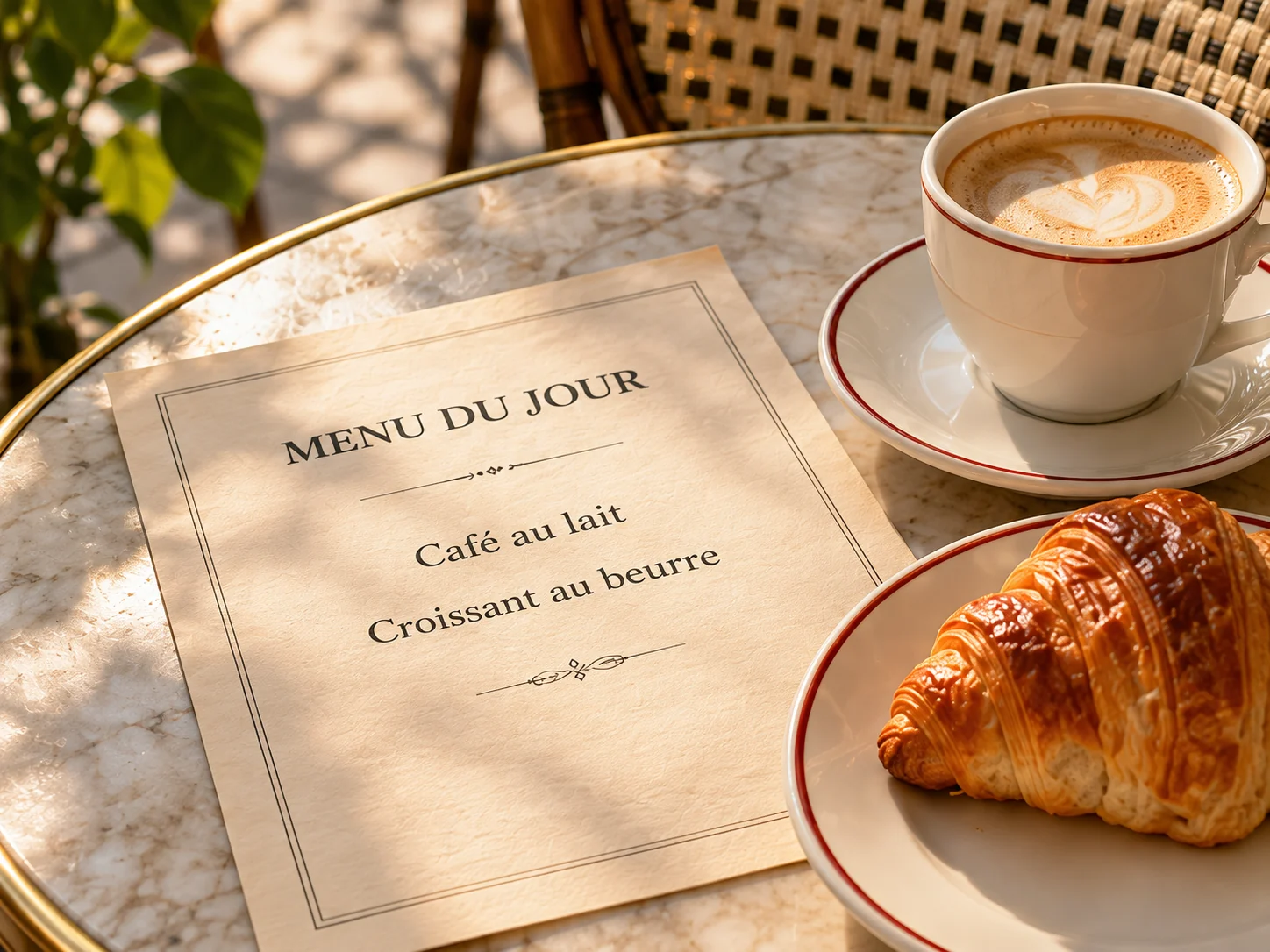
Keep l’addition in your café vocabulary: it means the bill. For dishes, look for la carte, le menu, le plat and le dessert. TV5MONDE’s café vocabulary includes audio for these words.
A menu may describe a set meal, while la carte lists dishes you can choose individually. Read the price and what is included before choosing. In French restaurant wording, an entrée is a starter; do not assume the English-language use of “entrée” as a main course applies.
When ordering, point to the actual dish and state your quantity. That makes the item clearer than reading a name you have only just encountered. For a longer description, use our guide to menu translation on iPhone, then confirm any ingredient questions with staff.
Ask for directions and recognise basic signs
| English | French |
|---|---|
| Where is the station? | Où est la gare ? |
| Where are the toilets? | Où sont les toilettes ? |
| One ticket to Lyon, please | Un billet pour Lyon, s’il vous plaît |
| Entrance / exit | Entrée / sortie |
| Open / closed | Ouvert / fermé |
| Right / left | Droite / gauche |
Notice how entrée changes with context: on a building it means entrance; on a restaurant menu it can mean starter. Read the surrounding words before deciding which meaning fits.
For a train journey, keep the exact station name and train number visible. Asking for “the station” only helps if both people mean the same place. At a ticket counter, show your destination, date and booking details as you ask the question.
What to say when the answer is too fast
Use plus lentement, s’il vous plaît for “more slowly, please,” or pouvez-vous répéter ? for “could you repeat?” Ask one short question at a time, and leave room for the answer.
If the difficulty is a number, look for the displayed price, departure time or platform. If it is a place name, show the spelling. The useful next step is to establish the detail you need, rather than translating a whole paragraph immediately.
Practise this point before leaving: say your greeting, ask a question, then open the written version of “I don’t understand.” It makes the fallback part of the routine instead of something you have to invent under pressure.
Keep a small phrase kit on your phone
Save six basic phrases, your café order, the accommodation address and the name of your arrival station. Keep French and English together. A note you can open without internet is enough for these prepared lines.
For a longer exchange, Spek, our iPhone app, offers France — French (France). Choose the two languages, hold the microphone while speaking, release to translate, and review the result before continuing. Swap the languages for the reply, as described in our conversation translation guide.
Spek requires internet and offers in-app purchases. Try the chosen language pair before travelling, and keep the saved phrase kit for occasions when you simply want to show a clear written request.